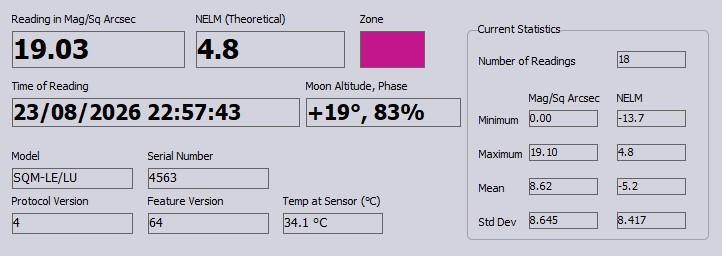
SQM Data for Oria
The "Sky Quality Meter" measures the brightness of the night sky in magnitudes per square arcsecond.
There are many uses in astrophotography for SQM data, it’s the best way to determine the true darkness and sky quality of an Observatory, the importance of this for good astrophotography is many fold.
CCD users can use the readings to determine the best nights and time of night to go hunting for the fainter targets that require the best clarity of sky.
The data can be used to adjust the settings in any given planetarium to give a true likeness on any given night, this can be a great aid when planning imaging sessions.
At ICAstronomy we use the Unihedron LE and the Unihedron L, the webpage version is the LE
We have an Average Astronomical darkness of 21.7 and we have recently hit our best at 21.97!
This is an excellent reading and will yield the very best data for deep sky photography.
Our Average readings put our skies somewhere between a Class1 and Class2 sky
- the zodiacal light is distinctly yellowish and bright enough to cast shadows at dusk and dawn
- airglow may be weakly visible near horizon
- clouds are only visible as dark holes against the sky
- surroundings are barely visible silhouetted against the sky
- the summer Milky Way is highly structured
- many Messier objects and globular clusters are naked-eye objects
- M33 is easily seen with naked eye
- limiting magnitude with 12.5" reflector is 16.5